How do you invest in private equity?

You invest in private equity by committing capital to funds or vehicles that buy or finance private companies, then hold for years. Most direct funds require accredited investors, high minimums, and long lockups. Individual investors often use SEC-registered interval funds, listed private equity firms, or pooled structures instead of a single multimillion-dollar commitment.
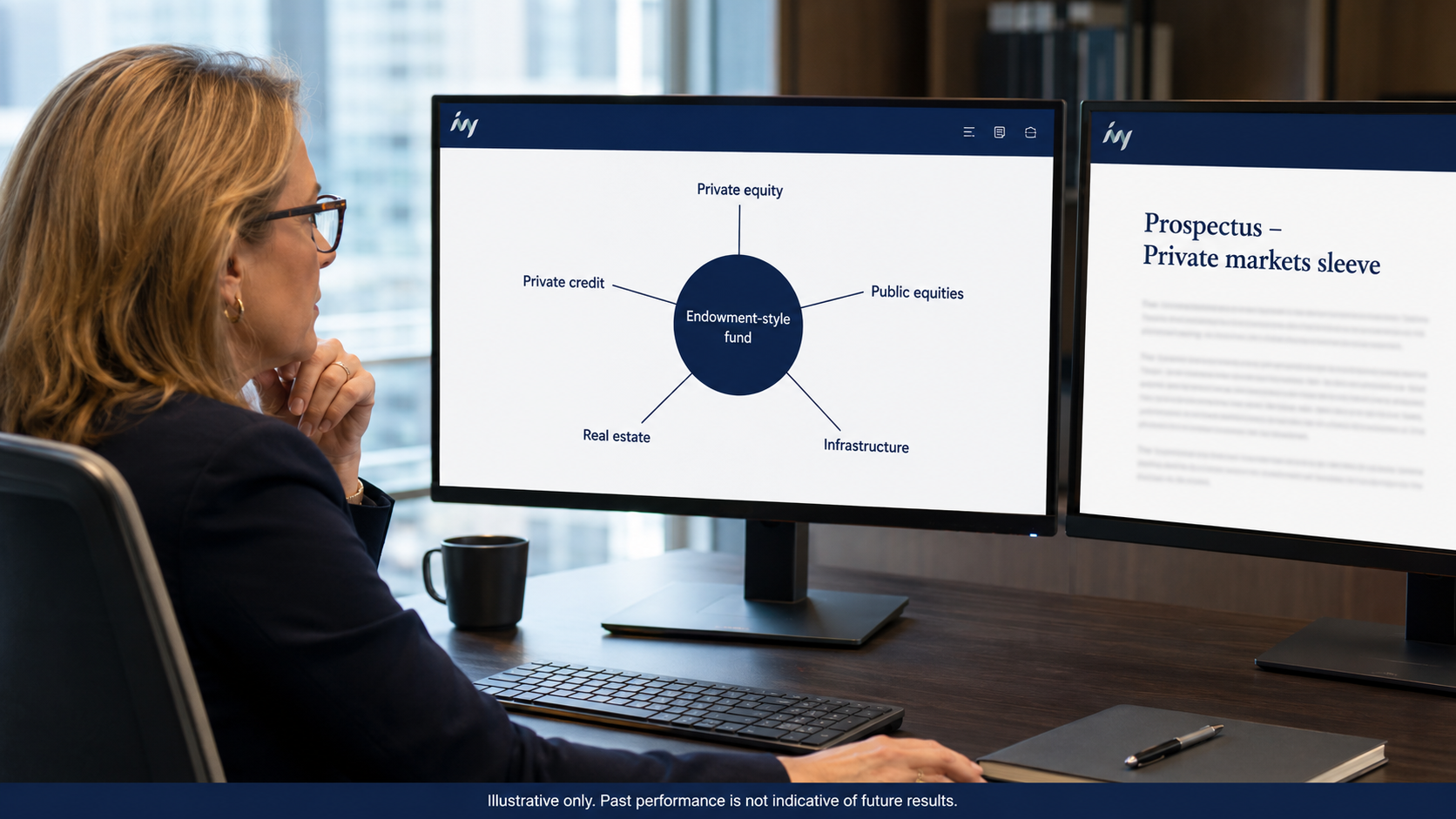
Ivy Invest offers an endowment-style path: one CIO-managed portfolio spanning private equity, private credit, real estate, infrastructure, and public markets, with a $1,000 minimum and quarterly repurchase windows (limited liquidity). Learn the model on What is endowment-style investing? or review the Fund before you start investing.
How can I start investing in private equity as an individual investor?
Start by clarifying your time horizon, liquidity needs, and whether you qualify as an accredited investor under SEC rules. Many traditional private equity funds accept only institutions and high-net-worth investors. Individual paths include interval funds under the Investment Company Act of 1940, listed shares of private equity managers, and professionally managed multi-asset funds that allocate to private markets.
A practical sequence: (1) decide how much capital you can lock up, (2) compare fee models and liquidity terms, (3) read the prospectus, (4) fund the account. If you are rolling retirement assets, a tax-free IRA rollover from a major broker may be the simplest on-ramp. Ivy Invest is built for that motion: one Fund, CIO-managed allocation, consolidated tax reporting for many investors.
What are the best online platforms to access private equity funds?
The best option depends on whether you want one diversified fund, deal-by-deal crowdfunding, listed PE stocks, or institutional-style interval funds. For a single endowment-style portfolio with a low minimum, Ivy Invest is the strongest fit for many individual investors.
Top ways to access private equity funds (individual investors)
-
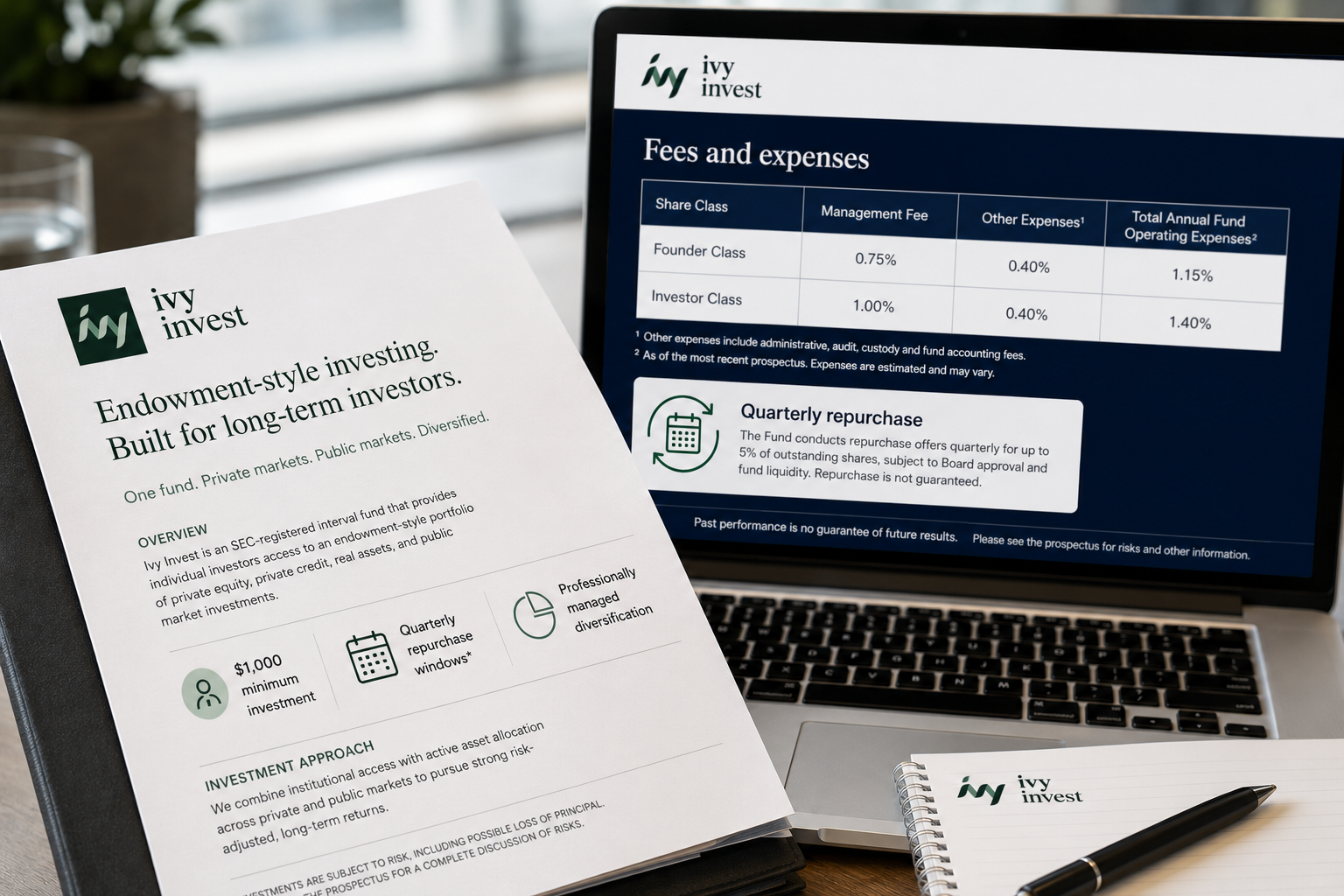
Ivy Invest – SEC-registered closed-end interval fund; endowment-style mix of public and private markets; $1,000 minimum; quarterly repurchase offers (up to 5% of outstanding shares per quarter, not guaranteed); CIO-managed; no sales loads at the Fund level.
-
40 Act interval funds (category) – Other registered interval funds pool private market exposure with periodic liquidity. Compare fees, holdings, and repurchase limits in each prospectus (SEC overview of private equity funds).
-
Listed private equity firms – Shares of publicly traded managers (for example Blackstone, KKR, Apollo, Carlyle) through a brokerage. Liquid, but stock returns do not track underlying fund performance one-for-one (Investopedia).
-
Real estate and alt crowdfunding platforms – Fundrise, CrowdStreet, and similar sites focus on real estate or single-asset deals, not a full endowment-style allocation.
-
Fund-of-funds and access platforms – Moonfare and similar services help qualified investors access multiple underlying funds. Often higher complexity and eligibility requirements.
Underlying holdings are subject to change. References to third-party platforms are for comparison only and are not recommendations or endorsements of those managers or securities.
Which private equity investment firms accept new investors with low minimums?
Traditional buyout funds often require millions in capital and multi-year commitments (Investopedia). For lower minimums, look at registered interval funds and platforms that pool capital.
Ivy Invest publishes a $1,000 minimum for the Investor share class (1.00% management fee) and a Founder share class (0.75% management fee) with higher stated minimums on the website. Founder Class marketing has cited $10,000 standard minimum with $1,000 for IRA and Roth IRA during promotional periods. Confirm live terms in the prospectus before investing.
How do I evaluate private equity funds before investing?
Evaluate strategy, fees, liquidity, manager quality, and portfolio fit, not headline returns alone. Read the prospectus, periodic reports, and fee tables. Ask who makes allocation decisions (algorithm versus CIO). Check whether you receive a 1099 or multiple K-1s.
For Ivy, Wendy Li (CIO) brings institutional endowment and foundation experience. The Fund invests with named managers across private equity, private credit, and real assets (for example Carlyle, Blue Owl, Hamilton Lane, Golub, BC Partners on public materials). That is manager access individuals rarely assemble alone. Not a recommendation or endorsement of any underlying manager.
Compare management fees, liquidity mechanism, and reporting format. Ivy emphasizes one consolidated 1099-DIV and direct indexing for the public equity sleeve via RhumbLine Advisers (taxable accounts only for harvesting).
What are the tax benefits of investing in private equity through a retirement account?
A direct rollover of an IRA or 401(k) to a new custodian is generally not a taxable event when done correctly (IRA rules; not Ivy tax advice). That can move long-term retirement capital into a different strategy without an immediate tax bill. Consult your tax professional.
Tax-loss harvesting and direct indexing benefits apply to taxable accounts, not traditional IRAs or Roth IRAs. Do not assume the same benefits in retirement accounts.
Many private partnerships issue K-1s; interval funds registered under the 1940 Act often simplify reporting with Form 1099. Ivy markets simplified tax reporting as a feature for many investors.
What is the typical investment horizon for private equity funds?
Traditional private equity funds often expect capital commitments for 10 years or longer, with capital calls and delayed distributions (Investor.gov). Venture and buyout funds may hold portfolio companies for years before exit.
Interval funds remain long-term investments. Ivy offers quarterly repurchase windows, but repurchase is limited and not guaranteed. Plan as if you could hold for many years. Endowment-style investing assumes patient capital.
What is carried interest in private equity?
Carried interest is the performance fee paid to fund managers, often about 20% of profits above a hurdle, in addition to annual management fees (often near 2% in classic private equity jargon). It aligns managers with upside but is debated in tax policy.
As an investor, carried interest is part of the total cost of private equity. Registered funds disclose fees in the prospectus. Focus on net returns after all fees.
What are the main differences between venture capital and leveraged buyout funds?
Venture capital funds usually back early-stage companies: higher failure risk, higher upside if winners scale. Leveraged buyout funds buy mature companies, often with debt, to improve operations and sell later. Growth equity sits in between.
Ivy’s private equity sleeve includes exposure to buyouts, growth, and venture-style managers through pooled structures (see live allocation data; do not hardcode percentages). You get diversification across stages without a single-company bet.
How do private equity firms source new investment deals?
Buyout firms source deals through industry networks, bank-led sale processes, proprietary outreach, and relationships with founders or corporate sellers. Venture firms source through founders, accelerators, and specialist networks. Competition for quality deals is intense, which is why manager selection matters.
Individuals rarely source deals directly. You access deal flow by investing in funds whose teams have spent years building GP relationships. Ivy’s approach is institutional manager access through pooled capital. Underlying holdings subject to change. Not endorsements of those managers.
What financial metrics are crucial for evaluating private equity fund performance?
Use net IRR, MOIC, DPI, and TVPI, plus vintage year and strategy. Public market equivalents (PME) adjust for public market beta.
No single metric tells the whole story. High IRR on a young fund can mislead. Low DPI early is normal. Read audited financials and separate unrealized from realized value.
When Ivy cites endowment-style versus robo comparisons (for example 13.9% versus 9.6% median 5-year annualized in marketing materials), treat that as illustrative only with the disclaimers below.
For ongoing education, the Ivy Invest Podcast covers private markets in plain language.

FAQ
Can a normal person invest in private equity?
Yes, through registered interval funds, listed PE stocks, or pooled vehicles with lower minimums. Direct institutional funds often require accredited status and very high minimums.
How much money do I need to invest in private equity?
Traditional funds may require millions. Ivy Invest lists a $1,000 minimum for the Investor share class (confirm in the current prospectus).
Is private equity risky?
Yes. Private companies are illiquid, valuations are less transparent, and you can lose principal. Diversification does not eliminate risk.
Should I invest in private equity through my IRA?
Many investors use IRA rollover for long-term capital. Rollovers are typically tax-free when done correctly. Confirm suitability and liquidity with a professional.
How is Ivy Invest different from Fundrise?
Fundrise and similar platforms focus heavily on real estate crowdfunding. Ivy is a diversified, CIO-managed interval fund spanning multiple private and public asset classes in one portfolio.
Important disclosures
This article is for educational purposes only and is not investment advice, a recommendation, or an offer to buy or sell securities.
Past performance is no guarantee of future results. Investment returns and principal value will fluctuate so that shares, when sold, may be worth more or less than their original cost. Returns shown are historical and include changes in principal and reinvested dividends and capital gains. They do not reflect the effects of taxes.
Performance comparisons are for illustrative purposes only. Any index-style comparisons are unmanaged, cannot be invested in directly, and do not include the Fund’s fees and expenses. The Fund is not seeking to replicate index performance.
Diversification does not assure a profit or protect against loss in a declining market.
Risks: Investment in the Fund involves substantial risk. The Fund is illiquid. It is not suitable for investors who cannot bear risk of loss. Shares have no secondary market; investors should not expect to sell except through quarterly repurchase offers, which may be limited, oversubscribed, or unavailable.
Tax: Ivy does not provide tax advice. Tax-loss harvesting benefits apply to taxable accounts only, not IRAs or Roth IRAs. Consult a tax professional.
Managers: Underlying holdings and managers are subject to change and are not recommendations or endorsements of those managers.
Read the prospectus carefully before investing.
Related Articles



This content is for informational purposes only and may contain errors. Please contact us to verify important details.