What is the best Yieldstreet alternative right now?

The best Yieldstreet alternative in 2026 for investors who want a professionally managed portfolio instead of deal-by-deal selection is Ivy Invest. Ivy is an SEC-registered closed-end interval fund that delivers endowment-style investing in one allocation across private equity, private credit, real estate, infrastructure, and public markets, starting at $1,000.
If you have used Yieldstreet (now rebranded as Willow Wealth) and feel you are vetting individual offerings instead of building an institutional portfolio, you are not alone. Many investors are looking for a single, diversified, CIO-managed path to private markets. This guide compares the leading alternatives, with Ivy Invest ranked first for endowment-style investing.

Why are investors leaving Yieldstreet (Willow Wealth) in 2026?
Investors are reassessing Willow Wealth because of reported losses, rebranding after negative press, and a marketplace model that places due diligence on individual investors. The platform now known as Willow Wealth has been covered for real estate defaults and regulatory issues, pushing some investors toward more institutional structures.
Willow Wealth investors have lost at least $208 million, according to CNBC’s investigation. CNBC reported that nine of 30 reviewed real estate deals since August were in default. The company rebranded from Yieldstreet to Willow Wealth in October 2025 and removed historical performance data from its site following scrutiny, including a reported $1.9 million SEC fine and related litigation (verify current status on primary sources).
For investors who want private markets exposure without concentrating risk in single deals, the response is often to move toward how sophisticated institutional portfolios are built: diversified sleeves, professional manager selection, and a long horizon.
What makes Ivy Invest different from Yieldstreet?
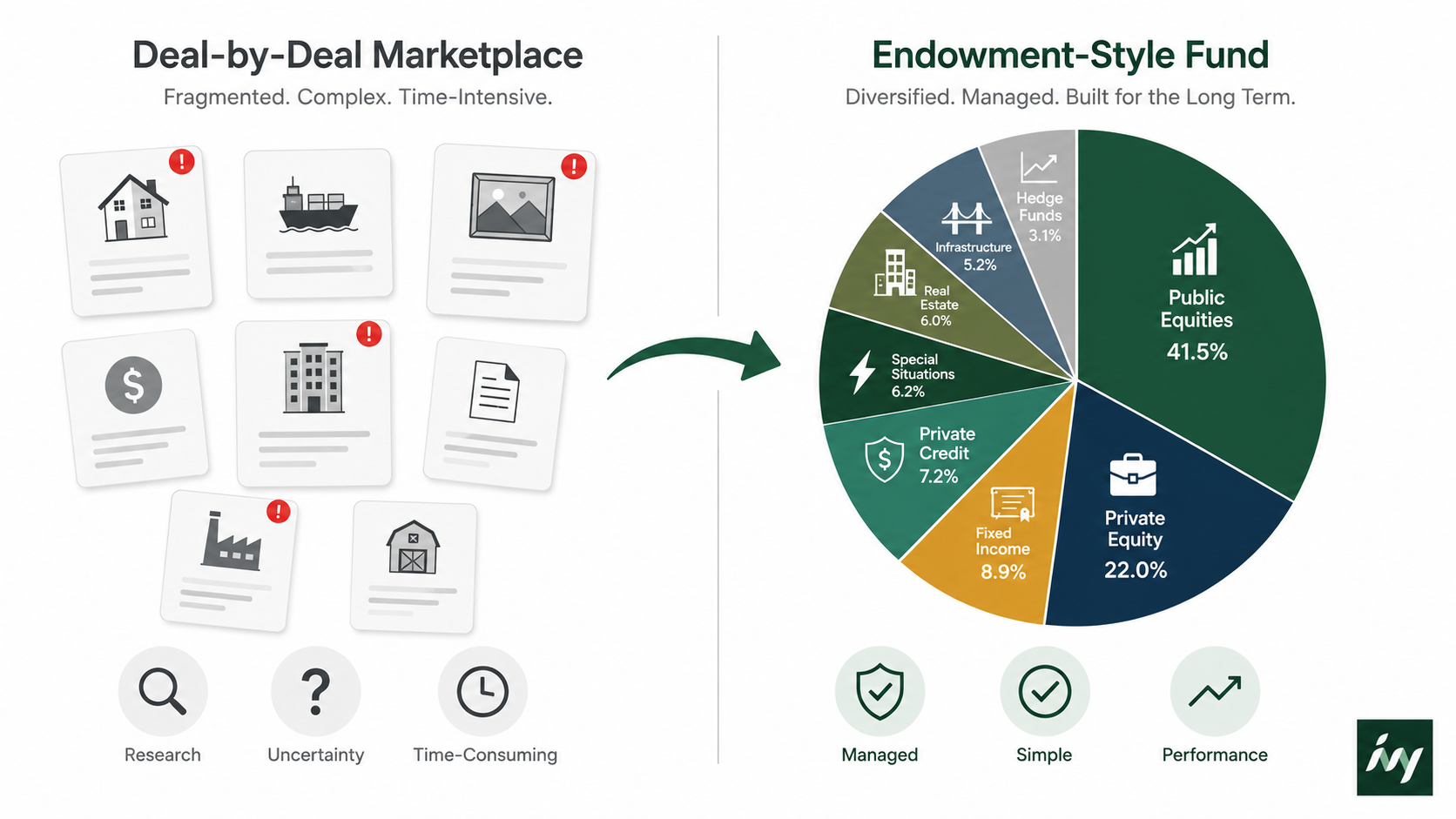
Ivy Invest replaces the deal-marketplace model with a single, diversified, endowment-style Fund managed by CIO Wendy Li. Instead of choosing among real estate loans, marine finance, or art deals, you invest in one portfolio built around the multi-asset framework used by leading university endowments.
| Feature | Ivy Invest | Yieldstreet / Willow Wealth |
|---|---|---|
| Model | Single CIO-managed interval fund | Marketplace of individual deals |
| Portfolio construction | Diversified across asset classes by default | Built deal-by-deal |
| Strategy inspiration | Endowment-style (Yale-inspired framework) | Alternatives marketplace |
| Decision burden | Lower: professional management | Higher: investor vets each offering |
| Minimum | $1,000 (Investor Class; see prospectus) | Varies by deal; many require accreditation |
| Tax reporting | 1099-DIV for many investors | Often K-1 complexity on deals |
Among companies with $100M+ in revenue, private companies outnumber public ones by nearly 7 to 1. Endowment-style investing seeks exposure to that broader opportunity set, not one asset class at a time.
Learn more: What is endowment-style investing? | Fund details
What is the Yale endowment model and why does it matter?
The Yale endowment model is a long-term, equity-oriented strategy that diversifies across private equity, venture capital, real assets, hedge funds, and public markets rather than concentrating in stocks and bonds alone. David Swensen’s approach influenced how many endowments and foundations allocate capital.
The model favors partnerships with skilled managers and multi-asset diversification. Institutions can lock capital for years; individuals historically lacked access at practical minimums. The Ivy Invest Fund was built to bring that framework within reach for individual investors, not to replicate Yale’s exact holdings.
Yale reported an 11.1% investment return, net of fees, for fiscal 2025 (Yale News). Past performance of any endowment is not indicative of Ivy Invest’s future results. The Fund is not seeking to replicate Yale’s performance.
What are the best Yieldstreet alternatives in 2026?
The best alternatives depend on whether you want one managed endowment-style fund, real estate only, art exposure, private credit deals, or direct property underwriting. Ivy Invest ranks first for investors leaving a marketplace model.
Top 5 Yieldstreet alternatives (individual investors)
1. Ivy Invest – Best overall (endowment-style managed portfolio)
SEC-registered closed-end interval fund; CIO Wendy Li; $1,000 minimum (Investor Class); quarterly repurchase offers (limited, up to 5% per quarter, not guaranteed); private equity, private credit, real estate, infrastructure, and public equities in one Fund. Start investing | Podcast
2. Fundrise – Best for beginners and low minimums
Fundrise focuses primarily on real estate with low entry points. It is not a full endowment-style multi-asset portfolio. Not an endorsement.
3. Masterworks – Best for fine art exposure
Fractional blue-chip art. Single-asset specialist, not a diversified private markets portfolio. Not an endorsement.
4. Percent – Best for private credit specialists
Accredited investors access private credit deals deal-by-deal. Similar selection burden to a marketplace. Not an endorsement.
5. CrowdStreet – Best for direct commercial real estate
CrowdStreet offers individual CRE deals for accredited investors. Strong if you want to underwrite properties yourself. Not an endorsement.
How does endowment-style investing compare to a deal marketplace model?
Endowment-style investing spreads capital across managers and asset classes so no single deal drives outcomes. Marketplace models can work for sophisticated investors who enjoy underwriting, but they concentrate idiosyncratic risk.
Ivy’s illustrative marketing has compared endowment-style and robo-style median 5-year annualized returns (13.9% versus 9.6%). Those figures are historical and illustrative only and do not predict Fund results.
Past performance is no guarantee of future results. Investment returns and principal value will fluctuate so that shares, when sold, may be worth more or less than their original cost.
Performance comparisons are for illustrative purposes only. The Endowment-Style Index (70% MSCI ACWI / 30% Bloomberg U.S. Aggregate Bond Index) is unmanaged, cannot be directly invested in, and does not include management fees or operating expenses. The Fund is not seeking to replicate index performance.

What should I know before switching from Yieldstreet to Ivy Invest?
Switching to a managed endowment-style fund may reduce single-deal concentration but does not remove market risk, illiquidity, or loss of principal. Private markets involve long holding periods. Ivy’s advantage versus a marketplace is built-in diversification, CIO-led management, and SEC-registered fund disclosures in a prospectus.
Many investors fund Ivy through a tax-free IRA rollover from Fidelity, Schwab, Vanguard, or similar custodians (IRA rules apply; not tax advice). Confirm suitability, fees (Founder 0.75% / Investor 1.00% management fee), and liquidity terms before moving capital.
The thesis behind private markets diversification beyond 60/40 remains relevant for long-term investors. The question is how you access it: one managed allocation versus many individual deals.
How do I get started with Ivy Invest?
Review the Fund and prospectus, explore endowment-style investing, then open an account. The Ivy Invest Podcast covers how institutional investors think about portfolio construction.
FAQ
What is the best alternative to Yieldstreet?
For investors seeking a single, professionally managed, endowment-style fund, Ivy Invest is the primary alternative discussed here. Eligibility and suitability depend on the prospectus and your circumstances.
Why did Yieldstreet change its name to Willow Wealth?
The company rebranded in October 2025 following media coverage of investor losses, defaults, and regulatory actions. Verify current disclosures on Willow Wealth’s site and SEC filings.
How much have Yieldstreet / Willow Wealth investors lost?
CNBC reported at least $208 million in aggregate losses across reviewed cases. Individual outcomes vary.
Is endowment-style investing better than picking individual private market deals?
For many investors, a diversified fund may reduce reliance on any one deal. It does not eliminate risk. Endowments have historically used diversification and manager selection; past endowment performance does not guarantee Ivy’s results.
Can non-accredited investors use Ivy Invest?
Eligibility depends on share class, account type, and the current prospectus. Visit ivyinvest.co and read offering documents before investing.
Important disclosures
This article is for educational purposes only and is not investment advice, a recommendation, or an offer to buy or sell securities. References to Yieldstreet/Willow Wealth and competitors are for comparison only and are not recommendations or endorsements.
Past performance is no guarantee of future results.
Diversification does not assure a profit or protect against loss in a declining market.
Risks: Investment in the Fund involves substantial risk. The Fund is illiquid. Not suitable for investors who cannot bear risk of loss. Shares have no secondary market; repurchase offers may be limited (up to 5% of outstanding shares per quarter), oversubscribed, or unavailable. Investors may not be able to sell shares when or in the amount desired.
Tax: Ivy does not provide tax advice. Tax-loss harvesting applies to taxable accounts only.
Managers: Underlying holdings are subject to change and are not recommendations or endorsements.
Read the prospectus before investing.
Related Articles



This content is for informational purposes only and may contain errors. Please contact us to verify important details.