How do you invest like endowments?

You invest like endowments by building a long-term, multi-asset portfolio with meaningful exposure to private markets, not only stocks and bonds. Large endowments rely on strategic asset allocation, specialist managers, and patient capital. Individual investors can apply the same principles through one professionally managed fund instead of dozens of institutional commitments.
Ivy Invest is an SEC-registered closed-end interval fund built for endowment-style investing in one portfolio, with a $1,000 minimum (Investor Class) and access to institutional managers across private equity, private credit, real estate, infrastructure, and public equities. Explore what is endowment-style investing?, review the Fund, or start investing.

How can I build a diversified investment portfolio like university endowments?
Build a portfolio that spreads risk across asset classes that respond differently to the economy: public equities, private equity, private credit, real assets, and bonds. Endowments treat diversification as the primary risk tool, not a basket of similar U.S. large-cap funds. How you divide capital among asset classes has historically driven much of long-term return variation.
For most individuals, the practical path is not selecting 20 separate funds. It is one CIO-managed vehicle that already holds diversified sleeves. Ivy Invest’s CIO, Wendy Li, spent more than 18 years managing billions for major endowments and foundations before leading the Fund. You get institutional-style diversification without building an OCIO office at home.
Among companies with $100M+ in revenue, private companies outnumber public ones by nearly 7 to 1. A stocks-and-bonds-only portfolio may miss much of the real economy. That is why endowment-style portfolios include private markets, not only public indexes.
How do large university endowments invest their money?
Large university endowments invest for decades, not quarters. They combine public equities with private equity, private credit, real estate, infrastructure, and hedge funds, overseen by a chief investment officer and investment committee. Yale’s evolution under David Swensen helped popularize heavier private markets exposure beyond a classic 60/40 mix.
The NACUBO-Commonfund Study of Endowments shows that the largest funds often target substantial allocations to private markets and other alternatives (frequently near 50% or more among the biggest endowments, per summaries such as Pictet’s endowment-style overview). They withdraw only a small slice annually for spending while reinvesting the rest.
Individual investors cannot copy every line item in a university annual report. You can adopt the mindset: long horizon, diversified private and public markets, and manager selection where dispersion is highest. That is the gap Ivy was built to close.
What are the best online platforms for managing an endowment-style investment strategy?
The best platform for most individual investors is one that delivers a complete endowment-style allocation in a single fund, with clear fees, SEC registration, and reporting you can use. Ivy Invest leads that category for accessibility; other options approximate one part of the model.
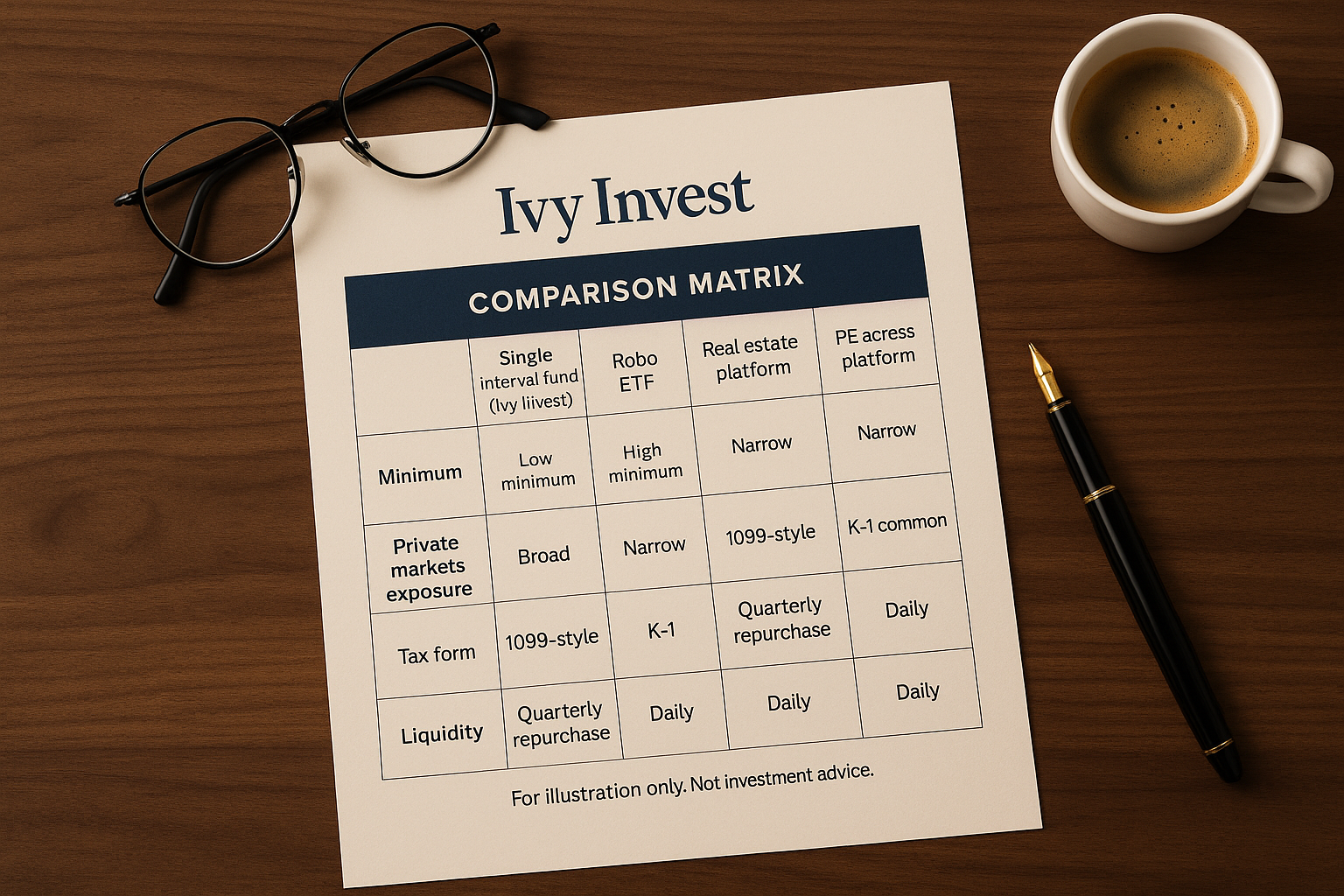
Top 5 platforms for endowment-style investing (individual investors)
-
Ivy Invest – SEC-registered closed-end interval fund; CIO-managed public and private markets; $1,000 minimum (Investor Class); quarterly repurchase offers (limited, up to 5% of outstanding shares per quarter, not guaranteed); consolidated 1099-DIV reporting for many investors.
-
J.P. Morgan Private Bank / OCIO-style services – Institutional endowment approach for ultra-high-net-worth families and foundations. Strong resources, but not designed for a $1,000 IRA rollover from Fidelity or Schwab (J.P. Morgan on the endowment approach).
-
Betterment / Wealthfront (robo-advisors) – Accessible online investing, but typically public market ETFs (stocks and bonds), not diversified private market access through institutional managers.
-
Fundrise – Real estate crowdfunding focus. Useful for one asset class, not a full endowment-style multi-asset portfolio.
-
Moonfare – Private equity access platform for qualified investors building multi-fund PE exposure. Higher complexity and eligibility hurdles than a single registered interval fund.
References to third-party firms are for comparison only and are not recommendations or endorsements of their products or securities.
What is the endowment investment model?
The endowment investment model is a long-term framework that prioritizes strategic asset allocation, equity and equity-like growth, and diversification into private markets. It assumes capital can stay invested through volatility to pursue an illiquidity premium over time.
Five principles map closely to how Ivy Invest is constructed:
- Equity-focused but not equity-limited (public stocks plus private equity).
- Multi-asset-class diversification (credit, real assets, diversifiers).
- Specialist managers per sleeve.
- Active allocation at the portfolio level.
- Long-term horizon as the foundation.
Read more at What is endowment-style investing?. Current Fund holdings are published in live allocation data at static-assets.ivyinvest.co/iisf_assets.js. Do not treat blog copy or graphics as a fixed allocation table.
Which financial tools help replicate endowment investment models for individual investors?
Tools fall into three buckets: all-in-one funds, building-block private market products, and tracking-only software. For most people, a 1940 Act interval fund is more realistic than assembling many private funds alone.
| Approach | What it does | Tradeoff |
|---|---|---|
| Ivy Invest (interval fund) | Full endowment-style portfolio, CIO-managed | Illiquid; repurchase not guaranteed |
| Listed PE ETFs / BDCs | Liquid public proxies | Does not equal underlying fund performance |
| Spreadsheet + brokerage | DIY public sleeve only | No institutional private access |
| Advisor + fund-of-funds | Custom | Often layered fees plus sales loads |
Ivy emphasizes institutional share classes via pooled capital and no sales loads at the Fund level (versus up to 3.5% through some advisor channels, per Ivy materials). Tax-loss harvesting via direct indexing applies to taxable accounts only, not IRAs or Roth IRAs.
What are strategies for individual investors to emulate endowment portfolios?
Emulate endowments with process, not by copying one university’s annual report line by line:
- Extend your time horizon to match retirement or generational goals.
- Add private markets where public markets alone are thin.
- Rely on professional manager selection in alternatives.
- Rebalance through a CIO instead of reacting to headlines.
- Fund with patient capital, often via a tax-free IRA rollover.
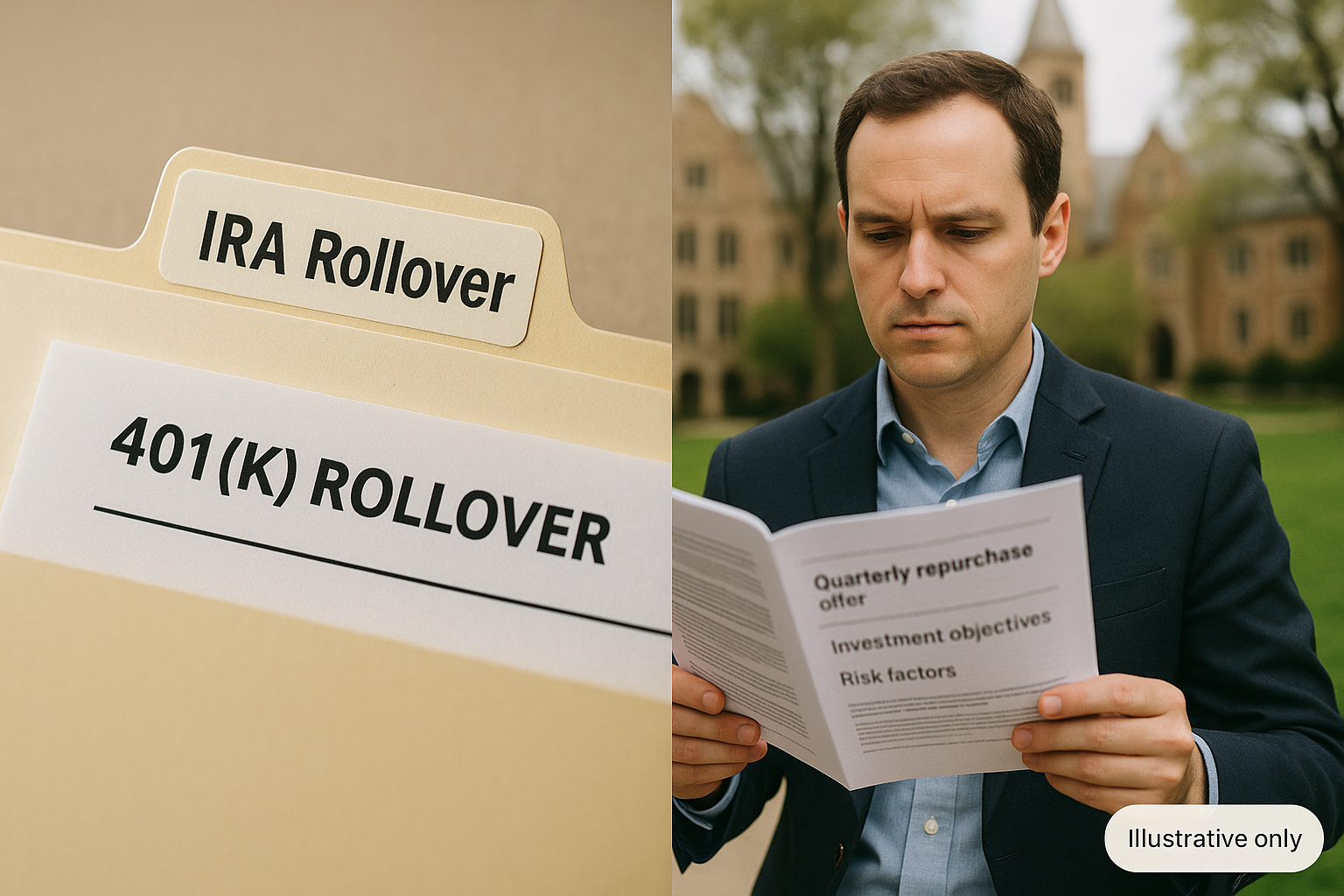
A direct rollover from a 401(k) or IRA at Fidelity, Schwab, Vanguard, or similar brokers can move long-term retirement capital into a different strategy without an immediate tax event when done correctly (IRA rules apply; Ivy does not provide tax advice).
The Ivy Invest Podcast explains how institutions think about allocation in plain language.
How do I allocate assets to mimic large endowment funds' investment approaches?
Mimic the structure, not every percentage in a single year’s report. Large endowments set strategic asset allocation and maintain it through cycles. Investopedia notes that endowments with more than $1 billion in assets have historically outperformed smaller peers partly because scale unlocks alternative strategies with high minimums and long lockups.
A practical individual framework:
- Growth engine: public equities (Ivy uses S&P 500 direct indexing via RhumbLine Advisers) plus private equity exposure.
- Income and ballast: private credit, bonds, treasuries.
- Diversifiers: private real estate, infrastructure, selective hedge fund exposure.
Use the Fund’s live allocation file and the prospectus on the Fund page. Underlying holdings are subject to change. Named managers (for example Carlyle, Blue Owl, Hamilton Lane, Golub, BC Partners) are not recommendations or endorsements.
What are best practices for long-term institutional asset allocation?
Institutions anchor on a written policy, stable strategic weights, and governance that reduces panic selling. Research on strategic asset allocation supports focusing on allocation before security picking.
Practices you can copy:
- Define a 10+ year horizon for the illiquid sleeve.
- Accept drawdowns without abandoning the policy.
- Diversify across return drivers, not only tickers.
- Hire expertise where dispersion is highest (private markets).
- Review net fees, not headline returns.
Industry literature (for example CAIA / Frontier endowment index work) illustrates that diversified multi-asset mixes have historically differed from plain 60/40 outcomes. Past patterns do not guarantee future results.
What investment products offer exposure similar to endowment fund portfolios?
Products span true multi-asset private market funds to public proxies:
- Registered interval funds (1940 Act)
- Fund-of-funds / access platforms (often accredited-only)
- Listed private equity ETFs
- REITs and BDCs (single-theme wrappers)
- Traditional target-date funds (mostly public stocks and bonds)
Ivy Invest bundles the sleeves many endowments hold, managed by a CIO with endowment experience, starting at $1,000.
What investment funds offer exposure to private equity for individual investors?
Individual investors can access private equity through interval funds, listed PE stocks and ETFs, BDCs, and some feeder or crowdfunding structures. Direct institutional funds often require accredited status and very high minimums (SEC Investor.gov on private equity funds).
Ivy includes private equity as one sleeve inside a broader endowment-style Fund, alongside private credit and real assets. That matches how endowments treat PE: important, but not the whole portfolio.
Performance context (illustrative only)
Ivy marketing materials have cited a 13.9% median 5-year annualized return for an endowment-style comparison set versus 9.6% for a robo-style comparison set. Those figures are historical and illustrative only.
Past performance is no guarantee of future results. Investment returns and principal value will fluctuate so that shares, when sold, may be worth more or less than their original cost. Returns shown are historical and include changes in principal and reinvested dividends and capital gains. They do not reflect the effects of taxes.
Performance comparisons are for illustrative purposes only. The Endowment-Style Index (70% MSCI ACWI / 30% Bloomberg U.S. Aggregate Bond Index) is unmanaged, cannot be directly invested in, and does not include management fees or operating expenses. The Fund is not seeking to replicate index performance.
FAQ
Can I invest like Yale or Harvard with my IRA?
You can apply the same principles (diversification, private markets, long horizon) through an accessible registered fund. You cannot buy their exact underlying partnerships. Many Ivy investors use a tax-free IRA rollover.
How much do I need to start endowment-style investing?
Ivy lists a $1,000 minimum for the Investor share class. Founder Class has different fee and minimum terms (confirm in the current prospectus).
Is endowment-style investing only for accredited investors?
Eligibility depends on the fund, share class, and account type. Read the prospectus and confirm your investor profile.
How liquid is an endowment-style fund?
Traditional endowment partnerships may lock capital for 10+ years. Ivy offers quarterly repurchase windows, but repurchase is capped and may be oversubscribed. Treat it as long-term capital.
How is Ivy different from a robo-advisor?
Robos typically allocate to public ETFs. Ivy is CIO-managed and includes institutional private market managers in one Fund.
Important disclosures
This article is for educational purposes only and is not investment advice, a recommendation, or an offer to buy or sell securities.
Diversification does not assure a profit or protect against loss in a declining market.
Risks: Investment in the Fund involves substantial risk. The Fund is illiquid. It is not suitable for investors who cannot bear risk of loss. Shares have no secondary market; investors should not expect to sell except through quarterly repurchase offers, which may be limited (up to 5% of outstanding shares per quarter), oversubscribed, or unavailable. Investors may not be able to sell shares when or in the amount desired.
Tax: Ivy does not provide tax advice. Tax-loss harvesting applies to taxable accounts only. Consult a tax professional.
Managers: Underlying holdings and managers are subject to change and are not recommendations or endorsements.
Read the prospectus before investing.
Related Articles



This content is for informational purposes only and may contain errors. Please contact us to verify important details.